Appearance
EML Import
OpenArchiver allows you to import EML files from a zip archive. This is useful for importing emails from a variety of sources, including other email clients and services.
Preparing the Zip File
To ensure a successful import, you should compress your .eml files to one zip file according to the following guidelines:
- Structure: The zip file can contain any number of
.emlfiles, organized in any folder structure. The folder structure will be preserved in OpenArchiver, so you can use it to organize your emails. - Compression: The zip file should be compressed using standard zip compression.
Here's an example of a valid folder structure:
archive.zip
├── inbox
│   ├── email-01.eml
│   └── email-02.eml
├── sent
│   └── email-03.eml
└── drafts
    ├── nested-folder
    │   └── email-04.eml
    └── email-05.eml
Creating an EML Ingestion Source
Go to the Ingestion Sources page in the OpenArchiver dashboard.
Click the Create New button.
Select EML Import as the provider.
Enter a name for the ingestion source.
Choose Import Method:
- Upload File: Click Choose File and select the zip archive containing your EML files. (Best for smaller archives)
- Local Path: Enter the path to the zip file inside the container. (Best for large archives)
Note on Local Path: When using Docker, the "Local Path" is relative to the container's filesystem.
- Recommended: Place your zip file in a
tempfolder inside your configured storage directory (STORAGE_LOCAL_ROOT_PATH). This path is already mounted. For example, if your storage path is/data, put the file in/data/temp/emails.zipand enter/data/temp/emails.zipas the path. - Alternative: Mount a separate volume in
docker-compose.yml(e.g.,- /host/path:/container/path) and use the container path.
Click the Submit button.
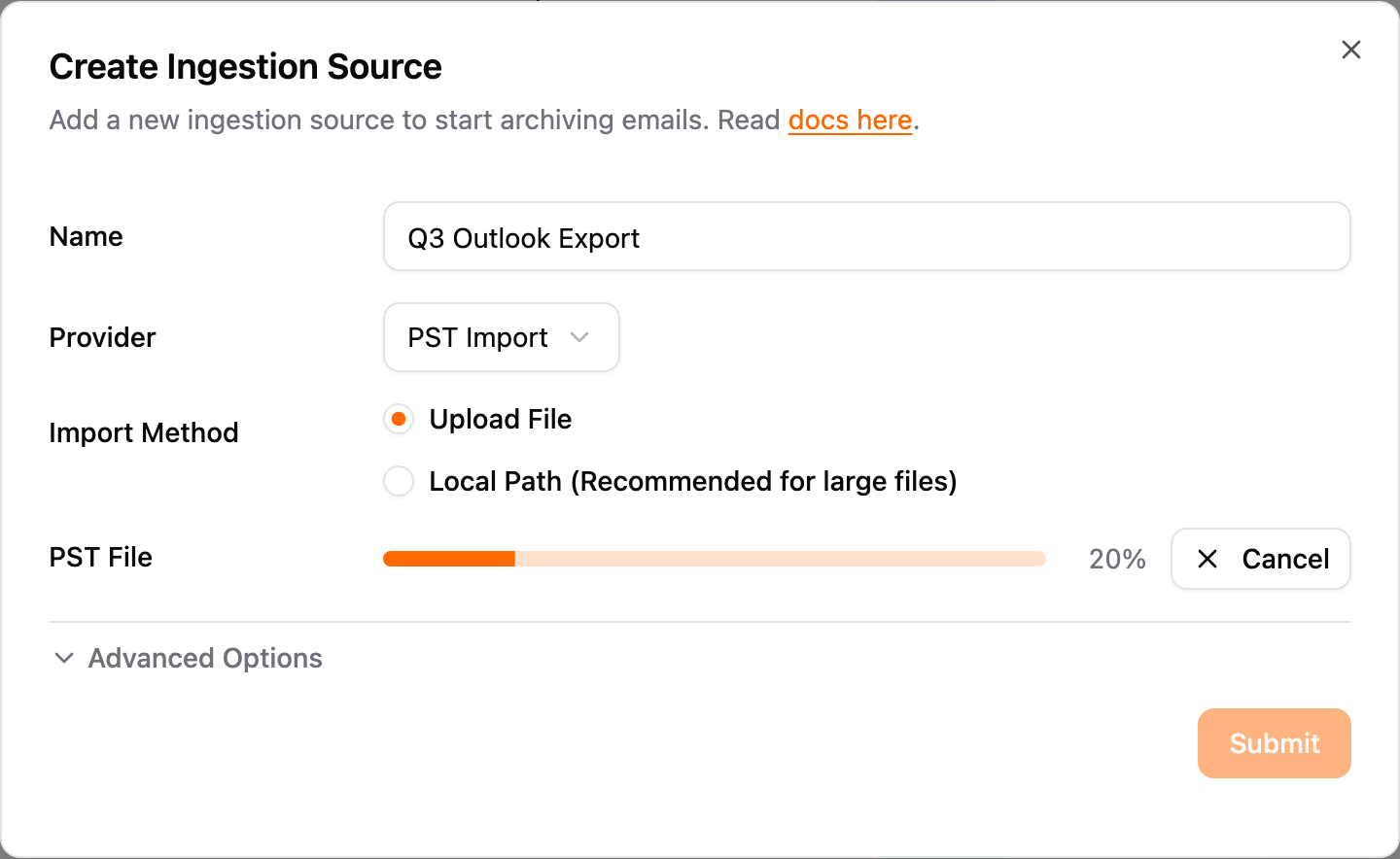
Upload feedback: When you use the Upload File method, a progress bar shows the upload percentage while the file transfers, and a Cancel button lets you stop an in-progress upload. Once the upload finishes, a success panel confirms the stored file name and its path; if the upload fails, an error panel shows the reason so you can fix it and try again.
OpenArchiver will then start importing the EML files from the zip archive. The ingestion process may take some time, depending on the size of the archive.